Snoring Evaluation & Sleep Therapy
Is Snoring Keeping You or Your Partner Up?
Find Out What's Behind It.
One night in a private sleep suite tells you whether it's just noise or sleep apnea. If it's apnea, there are therapy options that don't involve surgery or a CPAP mask.
- Free phone consultation with Dr. Herstein — no charge, no commitment
- Private, one-on-one overnight study — results the same week
- No surgery, no bulky CPAP unless your data says you need it
The consultation is a free phone call. The overnight study is a separate, self-pay service — we'll tell you the price before you book anything.
Or call or text
772-530-5878Request Your Free Consultation
Leave your details and we'll call you back — usually within one business day.
Thank you — we have your details
Someone from our office will call you within one business day to schedule your evaluation.
Need to reach us sooner?772-530-5878
Snoring, Or Something More?
Snoring isn't always harmless.
Snoring happens when tissue in a narrowed airway vibrates as you breathe. On its own it can be disruptive — to your sleep and to your partner's — without being dangerous.
But loud, frequent snoring is also the most recognizable warning sign of obstructive sleep apnea, a condition in which the airway repeatedly collapses during sleep and briefly cuts off airflow, often many times an hour, without fully waking you. Snoring is what people notice. Apnea is what does the damage — and roughly 80 to 90 percent of cases go undiagnosed.
The honest answer is that no one can tell you which one you have from a description. That is a measurement question, and this is how you get it measured.
Undiagnosed rate: Young T, Evans L, Finn L, Palta M. “Estimation of the clinically diagnosed proportion of sleep apnea syndrome in middle-aged men and women.” Sleep, 1997;20(9):705–706 — which found 82% of men and 93% of women with moderate-to-severe sleep apnea had not been clinically diagnosed.
Signs It's Worth Getting Checked
- Snoring loud or frequent enough to disturb someone else
- Morning headaches, or a dry mouth and sore throat on waking
- Waking up gasping or choking
- Pauses in breathing that a partner has noticed
- Daytime fatigue and trouble concentrating
- Sleep that never leaves you feeling rested
This list is a reason to get evaluated, not a diagnosis. Only a sleep study can tell you what is actually happening while you sleep.
What an Evaluation Involves
How You Find Out Which One You Have
There are two ways to measure sleep-disordered breathing, and they are not equivalent. Stuart Sleep performs comprehensive in-lab studies, because that is what separates simple snoring from apnea — and shows your physician which kind.
Why not a home test?
Home devices record breathing and oxygen, but not brain waves — so they can't tell how much you actually slept, or catch milder apnea. One night in our lab records all of it, scored personally by Dr. Herstein and interpreted by an independent physician.
What the Night Actually Looks Like
A Consultation First
We start with a free consultation covering your symptoms, your health history, and any sleep testing you have already had.
One Night, Private Suite
Arrive in the evening and sleep in a private, one-on-one room — not a shared lab. Sensors are applied before bed and a registered sleep technologist monitors the study through the night.
Scored Epoch by Epoch
Dr. Herstein personally scores your study rather than passing along a computer-generated summary. Auto-scoring is a starting point, not an answer. An independent board-certified sleep physician then interprets the study.
Answers the Same Week
You sit down with Dr. Herstein and go through what the data showed in plain language, typically within the same week — not after weeks of waiting.
After Your Results
Where Therapy Goes From There
What happens next depends entirely on what the study shows. We don't know which of these applies to you until we measure — and we would rather say that plainly than promise you a therapy before we have your data.
POxT — Positional Oxygenated Therapy — combines two well-established treatments, positional therapy and supplemental oxygen, into a single approach Dr. Herstein developed and refined in our lab. Gentle angular positioning keeps your airway open; a soft nasal cannula keeps your oxygen steady. It is patent-pending.
POxT involves no surgery, no implants, and no oral appliance to be fitted — a soft nasal cannula and a positioning system, that's it.

| What it asks of you | POxT | Standard CPAP |
|---|---|---|
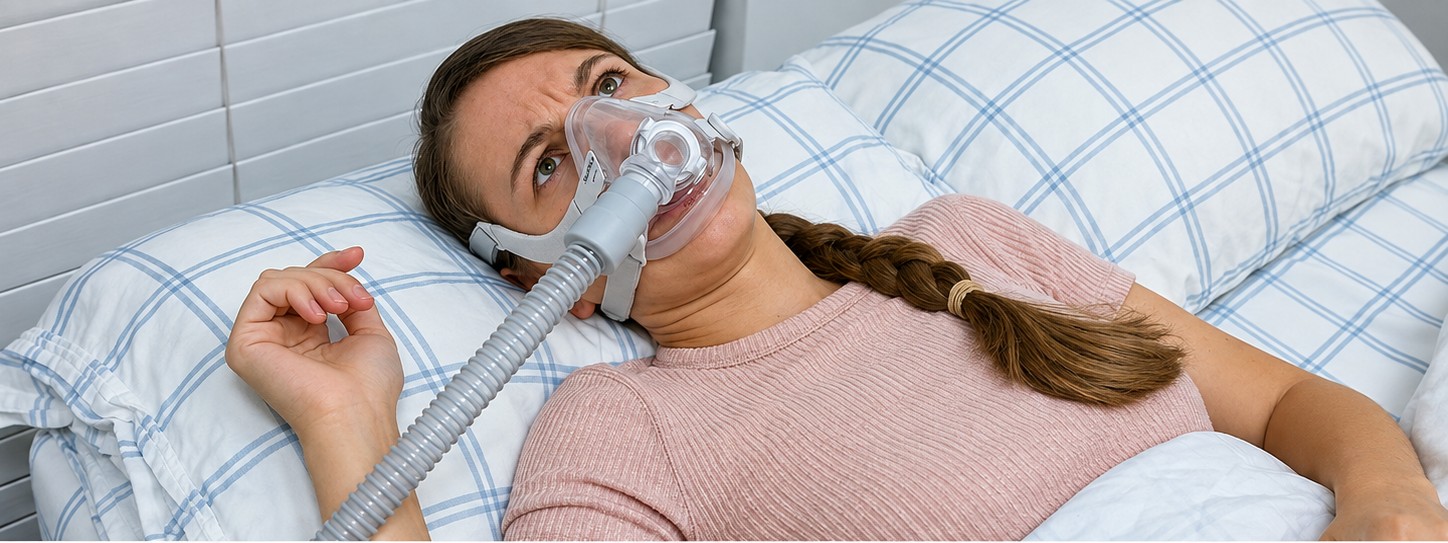
| On your face | A soft nasal cannula | A sealed mask and headgear |
| Moving in bed | Turn, talk, get up freely | Tethered to a bedside hose |
| Noise | Silent for you and your partner | Machine hum and mask leak |
| Side effects | No dryness, bloating or sores | Dry mouth, bloating, leaks, sores |
Among the patients we've studied in-lab with mild-to-moderate apnea, most reached normal breathing ranges on POxT. Your own study tells us whether you're a candidate.
If it's primary snoring
Snoring Without Apnea
If your study shows snoring without significant airway obstruction, you do not need apnea therapy, and we will tell you so. The conversation turns instead to what is driving the noise — sleep position, nasal airflow, alcohol timing, weight.
If apnea is severe
CPAP and Combination Therapy
For those people, the physician may order CPAP or BiPAP, often combined with our positional and oxygen-based methods. If you have already tried CPAP and stopped, that is worth telling us.
POxT is provided at Stuart Sleep under the order of a board-certified sleep physician. For some patients with severe sleep apnea, POxT may be part of a broader plan rather than a full replacement for CPAP — we'll tell you honestly what your data shows.

Who Scores Your Study
Dr. Richard Herstein
Dr. Herstein founded Stuart Sleep in 2024, after more than fifteen years as a registered polysomnographic technologist and a decade of executive leadership across hospital systems. He scores every study personally rather than passing along a computer-generated summary, before an independent board-certified sleep physician interprets it — which is why the lab takes one person a night.
Before You Book
Questions People Ask Us
One Night of Data
One Night. A Real Answer.
Start with a free phone consultation — no charge, no commitment. If a study makes sense, we'll tell you the price before you book.
Or call or text
772-530-5878We respond within 1 business day. For urgent medical concerns, call 911 or go to your nearest emergency room.
Request Your Free Consultation
Contact details only — we'll take everything clinical by phone.
Thank you — we have your details
Someone from our office will call you within one business day to schedule your evaluation.
Need to reach us sooner?772-530-5878